Building Decarbonization Roadmap
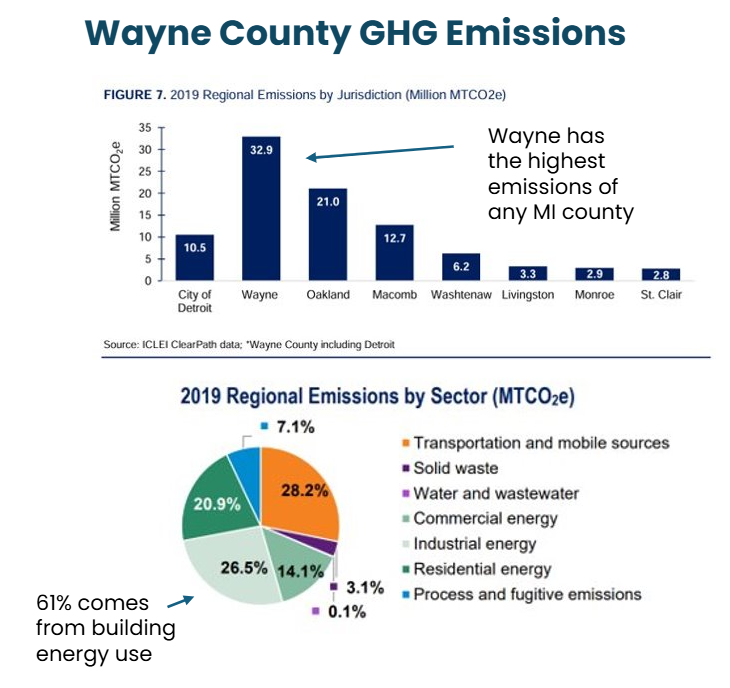
Wayne County has a higher population and produces more GHG emissions than any other county in Michigan. Of those emissions, around 61% are generated by energy use in buildings (SEMCOG, 2019). For the County to keep pace with the State’s climate goals and measurable targets, there is a clear need to lower building emissions in Wayne County. The BDR is the County’s first step towards describing the opportunities, challenges and strategies involved in advancing building decarbonization efforts.
Wayne County’s Building Decarbonization Roadmap (BDR) will identify and prioritize opportunities for countywide actors to align with the buildings-emissions reduction targets established by the State and SEMCOG. The purpose of this work is to establish a shared agenda for the actors, resources, and ecosystem surrounding the delivery of building retrofits and new construction in Wayne County. The BDR will propose a shared framework of implementation strategies for consideration at the local community level, including the identification and prioritization of new county-wide programs. Recognizing the diversity of conditions countywide, the BDR will identify separate guidance for residential, commercial, industrial and institutional buildings. It will lead with considerations of environmental justice, and spotlight workforce development and energy affordability.
Roadmap Goals & Targets:
MI Healthy Climate Plan, April 2022
- 52% reduction in GHG emissions by 2030, relative to 2005
- Full economy decarbonization by 2050
Michigan Comprehensive Climate Action Plan, December 2025
- Generate 60% of electricity from renewable sources by 2030
- Limit energy burden to less than 6% of annual income for low-income households
- Reduce emissions related to heating homes & businesses by 17% by 2030
- Deploy clean & innovative manufacturing technologies to reduce emissions in hard-to-decarbonize industries
SEMCOG Priority Climate Action Plan, February 2024
- Decarbonize households, saving at least 50% of energy use to homeowners. 80% of these homeowners will be in equity and environmental justice areas
- Decarbonize municipal buildings and facilities, reduce energy use by at least 50% and replace internal heating and cooling systems with zero emissions alternatives
- Decarbonize small to medium commercial and industrial buildings in equity and environmental justice areas by 2030

-
Phone (313) 716-9842 Email ibertman@waynecountymi.gov